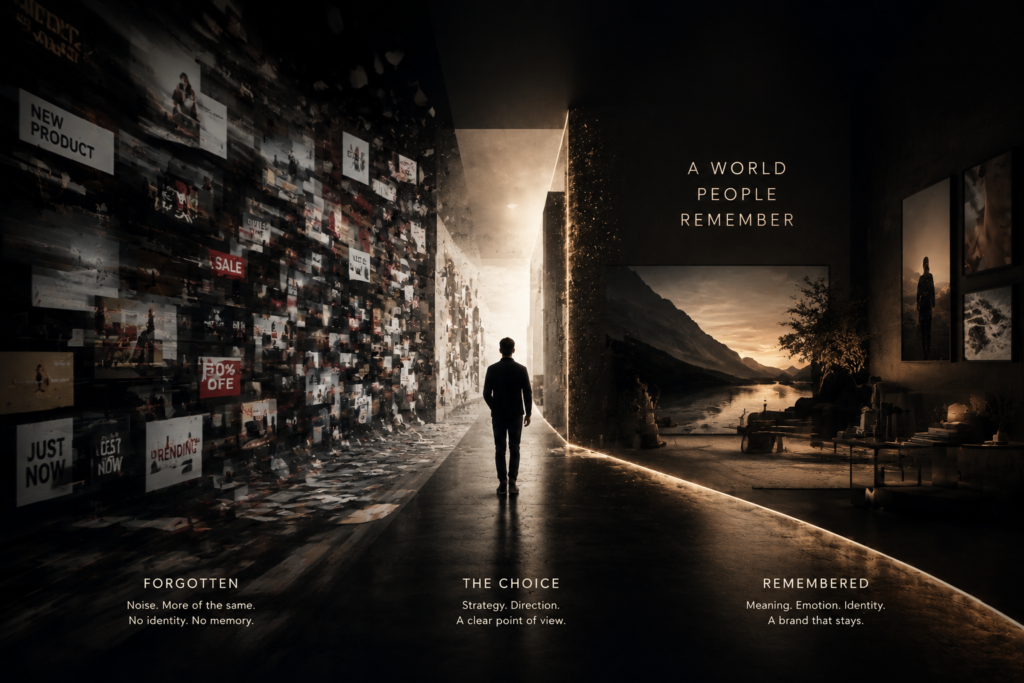
Every brand wants to be remembered.
They create campaigns.
They publish content.
They invest in advertising.
They produce videos, images, and stories.
Yet despite all this effort, many brands disappear from people’s minds almost immediately.
The question is:
Why do some brands stay with us while others are forgotten?
The answer is not simply more visibility.
It is not more content.
It is not even better production.
Memorable brands create something deeper:
A connection.
Attention Is Easy. Memory Is Hard.
The modern attention economy has created an endless competition.
Every day, audiences see thousands of:
- images
- advertisements
- videos
- messages
Brands are constantly trying to capture attention.
But attention is temporary.
A person may notice a campaign today and forget it tomorrow.
Memory works differently.
Memory is created when something has meaning.
When a brand creates a feeling.
When an experience becomes recognizable.
The strongest brands do not only ask:
“How can we be seen?”
They ask:
“How can we become meaningful?”
The Difference Between A Visible Brand And A Memorable Brand
A visible brand is everywhere.
A memorable brand is somewhere specific in people’s minds.
Visibility comes from repetition.
Memory comes from identity.
A brand becomes memorable when people can recognize:
- its personality
- its perspective
- its visual language
- its emotional world
This is why some brands can remove their logo and still be recognized.
Their identity exists beyond the name.
Memorable Brands Build Meaning, Not Just Messages
Many brands approach communication as individual pieces:
One campaign.
One advertisement.
One social post.
One product launch.
But strong brands think differently.
They build a larger story.
Every visual, message, and experience becomes part of the same world.
This is where brand storytelling becomes important.
Storytelling is not only about telling stories.
It is about creating meaning.
The Role Of Emotion In Brand Memory
People do not remember information the same way they remember experiences.
A product feature can be forgotten.
A feeling can stay.
Emotion creates stronger connections because it gives information a place in memory.
Memorable brands understand this.
They do not only communicate:
What they sell.
They communicate:
Why it matters.
They create feelings around:
- trust
- desire
- confidence
- curiosity
- belonging
Visual Identity Creates Recognition
A strong visual identity is one of the most powerful tools for memory.
Not because it makes a brand look attractive.
Because it creates consistency.
Visual identity includes:
- colors
- typography
- composition
- imagery
- motion
- materials
- atmosphere
These elements create a recognizable language.
A strong brand does not create random beautiful visuals.
It creates visuals that belong together.
Why Random Creativity Makes Brands Forgettable
Today, AI and digital tools allow brands to create more content than ever.
But more content can create a problem.
Without creative direction:
- every campaign feels different
- visuals follow temporary trends
- the audience cannot recognize the brand
- meaning becomes diluted
A brand can become visually impressive but strategically invisible.
Creativity without direction creates noise.
Creative systems create recognition.
Creative Direction Is What Connects Everything
Creative direction transforms separate ideas into a unified experience.
It connects:
- strategy
- storytelling
- visuals
- emotion
- audience
A creative director asks:
Does this represent the brand?
Does this strengthen the identity?
Does this create the right feeling?
Does this help people remember us?
These decisions create the difference between a campaign that is simply seen and a campaign that stays.
Memorable Brands Create Their Own World
The strongest brands do not only compete inside a category.
They create their own space.
They build a world people recognize.
This world includes:
- beliefs
- emotions
- visual language
- experiences
When people enter that world, they understand what the brand represents.
This is why the future of branding is not only about creating content.
It is about creating meaning.
AI Changes Production. It Does Not Change The Principles Of Memory.
AI has transformed how quickly brands can create.
But the fundamentals of memorable brands remain the same.
Technology can help produce more.
But brands are still remembered because of:
- clarity
- emotion
- consistency
- meaning
AI can generate possibilities.
But creative strategy decides what becomes memorable.
WildVibe Perspective
We believe the strongest brands are not the ones that create the most content.
They are the ones that create the strongest connections.
In a world where everyone can produce more, being recognizable becomes more valuable.
A memorable brand is not built from isolated moments.
It is built from a consistent world of ideas, emotions, and experiences.
People may forget what they saw.
But they remember what they felt.
— Studio WildVibe Perspective
Conclusion
Being visible is not the same as being remembered.
Brands do not become memorable because they appear everywhere.
They become memorable because they mean something somewhere.
The future belongs to brands that create:
Clear ideas.
Strong identities.
Meaningful experiences.
Because attention disappears.
But memory builds brands.
Want to build visuals that people remember?
Explore our creative work or start a conversation with Studio WildVibe.