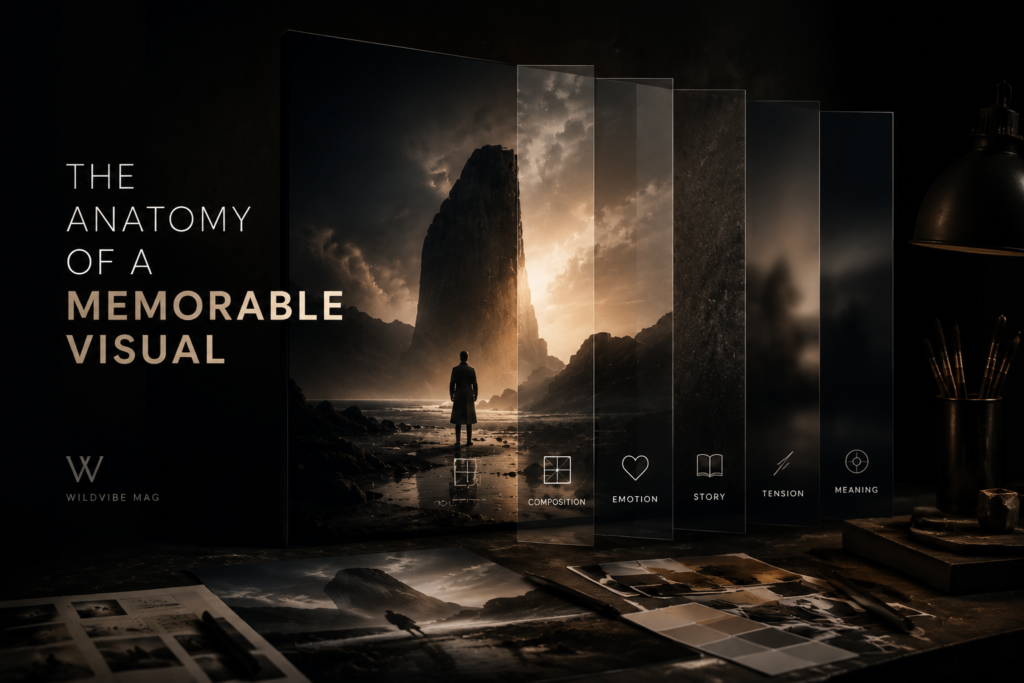
Every day, we see thousands of images.
Advertisements.
Campaigns.
Social media posts.
Product visuals.
Most of them disappear almost instantly.
But sometimes an image stops us.
We remember it.
We return to it.
Years later, we can still describe how it made us feel.
What creates this difference?
Why do some images become memorable while others disappear?
The answer is not only beauty.
A memorable visual is built through a combination of meaning, emotion, and intention.
Beauty Is Not Enough
In today’s creative landscape, beautiful images are everywhere.
With modern tools and AI creative production, creating visually impressive content has become more accessible than ever.
Perfect lighting.
Beautiful colors.
High-quality details.
These elements are easier to achieve.
But visual quality alone does not create impact.
A beautiful image can attract attention.
A meaningful image creates memory.
The difference is what exists beneath the surface.
A Memorable Visual Starts With An Idea
Every strong visual begins before the image exists.
It begins with a thought.
A question.
A message.
A perspective.
Without an idea, visual creation becomes decoration.
With an idea, every creative decision has a purpose.
Before asking:
“How should this look?”
Strong creators ask:
“What should this communicate?”
1. Composition: Guiding The Eye
Composition is the structure behind an image.
It determines:
- where attention goes
- what feels important
- how the viewer experiences the scene
A strong composition does not simply place elements beautifully.
It creates a visual journey.
The viewer’s eye moves through the image.
It discovers relationships.
It understands hierarchy.
Great composition creates order inside complexity.
2. Contrast: Creating Attention
Without contrast, everything becomes equal.
And when everything is equal, nothing stands out.
Contrast can exist through:
- light and shadow
- scale
- color
- movement
- silence and noise
Contrast creates tension.
Tension creates curiosity.
Curiosity keeps people engaged.
A memorable visual often contains a relationship between opposing forces.
3. Emotion: Creating Connection
People rarely remember images only because of what they see.
They remember what they feel.
Emotion transforms an image from information into experience.
A visual can communicate:
- hope
- curiosity
- desire
- confidence
- mystery
- belonging
The strongest brand visuals do not only show a product.
They create a feeling around the product.
4. Story: Giving The Image Meaning
A powerful image suggests something beyond itself.
It creates questions.
What happened before this moment?
What will happen next?
Who are these people?
Why does this scene matter?
Story does not always require characters or a clear narrative.
Sometimes a single object, environment, or gesture can suggest an entire world.
Story gives an image depth.
5. Tension: Making People Look Again
One of the most overlooked elements of memorable visuals is tension.
Tension creates a reason to stay.
It can come from:
- unexpected combinations
- unusual perspectives
- contrast between ideas
- something slightly unfamiliar
Perfect images are often forgotten.
Interesting images stay.
A memorable visual usually contains a question.
The Role Of Creative Direction
The elements of a memorable visual do not happen by accident.
They are connected through creative direction.
Creative direction defines:
- what the image should communicate
- what emotion it should create
- how every element supports the idea
Without direction, visuals can be beautiful but disconnected.
With direction, every choice becomes meaningful.
AI Can Create Images. It Still Needs Visual Thinking.
AI has changed how quickly we can explore visual possibilities.
It can generate:
- different styles
- different compositions
- different worlds
But a memorable visual still requires human judgment.
Because the challenge is not only creating an image.
The challenge is creating the right image.
AI expands possibilities.
Creative thinking gives them purpose.
Why Brands Need Memorable Visuals
For brands, visuals are not decoration.
They are communication.
Every image contributes to how people understand the brand.
Weak visuals create temporary attention.
Strong visuals build recognition.
A memorable visual helps audiences understand:
Who the brand is.
What it believes.
Why it is different.
The Future Of Visual Communication
As AI makes visual creation easier, the number of images will continue increasing.
This means attention will become more difficult to earn.
Brands will not compete only through production quality.
They will compete through meaning.
The winners will be the brands that understand:
A visual is not just something to see.
It is something to experience.
WildVibe Perspective
We believe the future of visual creation is not about making more images.
It is about creating images that deserve to exist.
A memorable visual is not created by adding more details.
It is created by making better decisions.
Every composition.
Every emotion.
Every choice.
Should serve a purpose.
Because beauty can attract attention.
But meaning creates memory.
— Studio WildVibe Perspective
Conclusion
A memorable visual is more than a beautiful image.
It is a combination of:
Idea.
Emotion.
Story.
Composition.
Intent.
In a world where images are becoming unlimited, the ability to create something meaningful becomes more valuable.
The future belongs to those who do not just create visuals.
They create experiences.
Want to build visuals that people remember?
Explore our creative work or start a conversation with Studio WildVibe.